The public image of the writer Ernest Hemingway is clearly defined: an adventurer, a man who enjoyed life’s pleasures, a womanizer, and a man of action. A rough-and-tumble brawler—whether at war, on safari, or at a bar counter. Yet this superficial view falls short, overlooking his inner self — the contemplative and spiritual Hemingway.
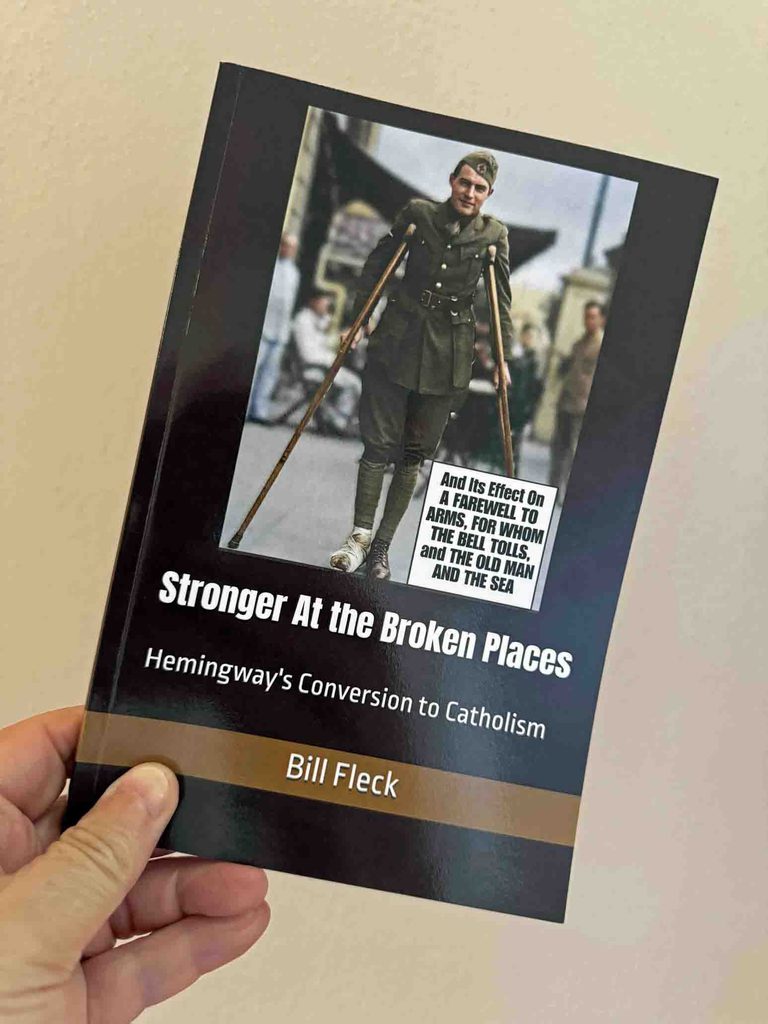
Bill Fleck’s book, Stronger at the Broken Places: Hemingway’s Conversion to Catholicism, fills precisely this gap. Originally written as a master’s thesis under the guidance of renowned Hemingway scholar H. R. Stoneback, the work thankfully sheds light on the Nobel laureate’s life of faith.
Ernest Hemingway – born in 1899 in Oak Park, near Chicago – grew up in a household shaped by Congregationalism. This faith community originated in the English Puritan movement and is deeply rooted in the Calvinist tradition, characterized by a strict belief in God, ambition, and industriousness. As the years went by, the young Hemingway found the rigid principles of his Protestant suburban family stifling. Once he left home, he turned away from that moral world.
A severe wound sustained on the Venetian front during World War I eventually drew him closer to Catholicism: while in an Italian field hospital in July 1918, he received the Anointing of the Sick and was baptized into the Catholic faith. His marriage in May 1927 to his second wife, Pauline Pfeiffer — who came from a devoutly Catholic family – initially strengthened his religious ties.
During the Spanish Civil War, however, Ernest distanced himself from the faith – largely due to the Spanish Catholic Church’s support for the coup leader General Franco. During World War II, following the brutal Battle of Hürtgen Forest, Hemingway once again sought solace in faith. The horrors of war on the German Western Front near Aachen during the winter of 1944–45 ultimately led him back to the world of the Catholic faith.
After 1945, a quiet Catholicism shaped Hemingway’s daily life – not in an ostentatious way, but rather privately and inwardly. At his Cuban estate, Finca Vigía, the tradition of eating fish on Fridays was observed. It went beyond mere outward observances: the exiled Basque priest Father Andrés Untzaín became a close friend, confessor, and spiritual guide to him in Cuba. During his many travels, Hemingway regularly visited cathedrals – often to light candles for deceased friends and relatives.
Ernest did not make a public show of his Catholicism, preferring instead to cultivate his image as a rough-and-tumble brawler. Yet, correspondence with colleagues and priests bears witness to the true state of Hemingway’s spiritual life. It is no coincidence, then, that the American felt most at home in staunchly Catholic countries like Italy, Spain, and Cuba.
Bill Fleck deserves credit for having examined and compiled these biographical traces. In the final third of his book, the American educator explores